
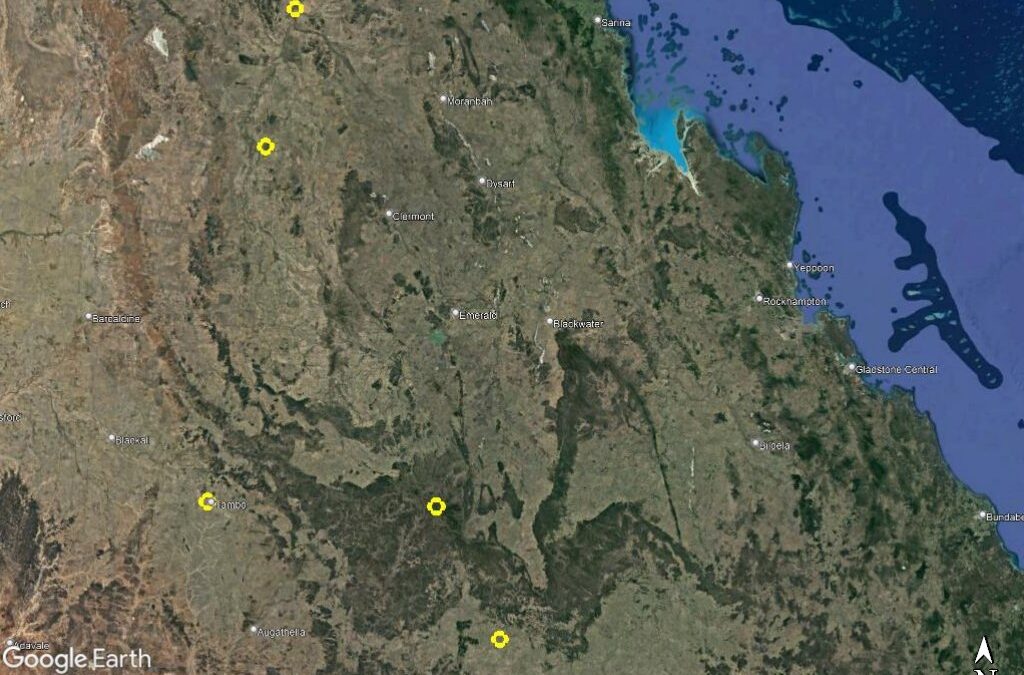
The last population group of northern hairy-nosed wombats, the best known, is located in central Queensland, in the Epping Forest National Park.
The National Park is 110 km north-west of Clermont in central Queensland. Excellent population recovery work is being undertaken on the species now.
The first confirmed report of northern hairy-nosed wombats in Epping Forest was not made until 1937. This was well after the populations in NSW and southern Queensland had disappeared, so at that time it was akin to discovering survivors of a population that was thought by many to be extinct. Despite this, it is almost certain that locals would have been aware of the presence of wombats in the area since European colonisation in the 1860s. The distribution in Epping Forrest at the time of the first report was said to cover a small area of approximately 10 km x 2 km, but this would have described a population that had already been subjected to the pressures associated with agriculture and introduced species. So unfortunately while we do not have any information on the likely distribution and abundance of wombats in the region at the time of European colonisation, it is likely to have been much larger than it was in 1937, as there is evidence that the population had undergone a number of contractions during the first half of the twentieth century.
Inspections of the area between 1974 – 1982 revealed traces of disused wombat burrows on Alinya Station (formerly known as Laglan Station in the 1930s) 5 km to the west of Epping Forest, and at ranges of up to 2 km to the south, east and north-east of the extant wombat distribution. Another colony was said to have existed near the Sandy Camp waterhole, approximately 10 km west of the present colony. Local residents suggest that wombats disappeared from some of these areas at about the same time as hairy-nosed wombats were first revealed to the general public in the late 1930s, with further contractions occurring in the 1960s.
In addition to the Epping Forest population, there have also been a number of unconfirmed reports of wombats having been sighted at several other locations in central Queensland in the early decades of the twentieth century, including Carnarvon National Park, Injune, Tambo, and Mt Douglas. Whilst some caution should be exercised in regard to these reports, their locations indicate the possibility that the St George and Epping Forest populations should not be considered in isolation. Rather, both sites may merely have represented the densest population groups of a geographically large – but extremely patchy – population along the western slope of the Great Dividing Range in southern and central Queensland.
The most commonly accepted explanation for the declines in the central Queensland wombat population during the first half of the twentieth century is competition from cattle grazing, especially during periods of drought. Rabbits can be largely discounted as a major factor as they did not arrive in the Epping Forest area until after 1940, and even then they were in small numbers only. However, it is possible they may have had an influence on the continuing decline in abundance in the second half of the century.
The next page has some final thoughts and collates all the information on Northern Hairy-nosed wombats in a single distribution map.
Then you can find out more about Bare-nosed (common) wombats.