
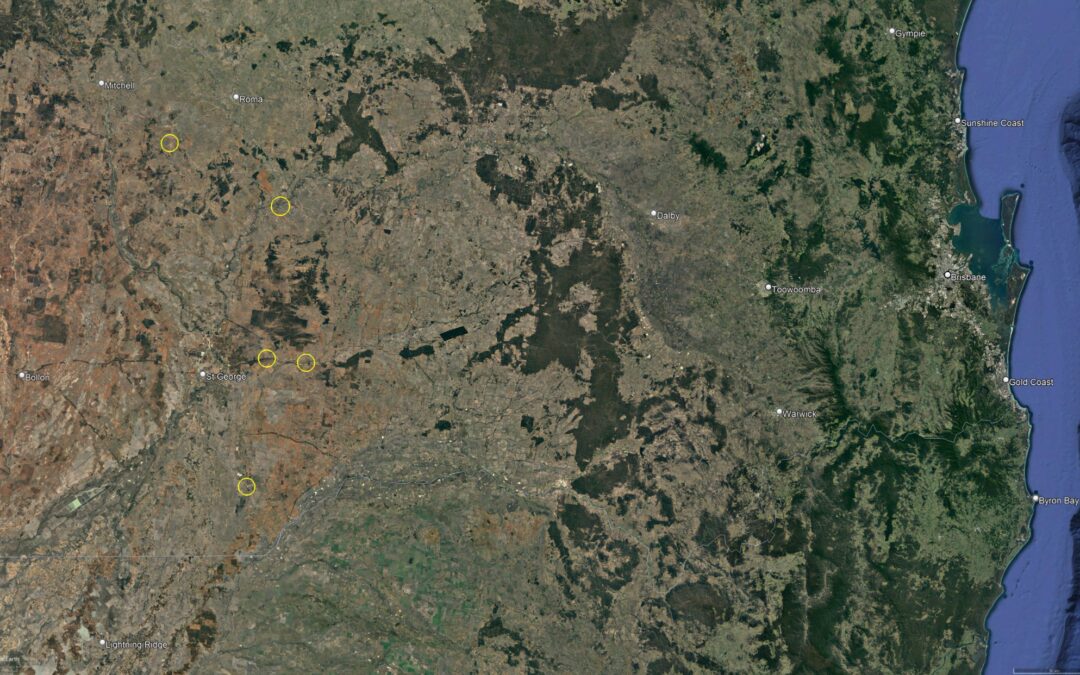
This is about the second population group of Northern Hairy-nosed wombats – the one that was first recorded; in southern Queensland.
The first report of hairy-nosed wombats in Queensland was by Major Sir Thomas Mitchell in May 1846. In his journal Mitchell describes the red rock of the country as being ‘hollowed out by some burrowing animal’. The location of this report was from near Mount Red Cap, 140 km to the north of St George, which is the location of the translocated colony in the Richard Underwood Nature Reserve. Mitchell’s report was followed up by Ludwig Leichhardt in 1847, who describes the burrow and traces of an unknown animal at two locations near where the town of Surat now stands. In the first, on the 26 August 1847, Leichhardt described the burrow of an unknown animal ‘the size of a beaver’, and mentioned tracks that, ‘resembled that of a child’. On 7 September 1847, Leichhardt wrote ‘we saw again the burrows of the new animal in the red soil… and there were many holes close together’.
In addition to the early reports by explorers, wombats were reported by locals ~ 40 km to the east of St George as early 1861, despite there being scepticism shown in some quarters to the reports. As a result, the presence of hairy-nosed wombats in Queensland was not confirmed until 1900, from an examination of three specimens which had been obtained between 1891 – 1899 along the Moonie River. They were immediately recognised as being different to both the common wombats which inhabited the Stanthorpe region and the Southern Hairy-nosed wombats of SA, and they were assigned the taxonomic nomenclature Phascolomys gillespiei at the time.
These three specimens were reported to have come from just north of St George and from a few miles east of Thallon, 80 km further south. Taken together with the sightings by Mitchell and Leichhardt, the geographic extent of this population would have extended about 200 km N/S x 60 km E/W. Mitchell’s and Leichhardt’s journals also provide an insight into the likely abundance of wombats in the region. Although Mitchell started his 1846 journey from St George’s Bridge (now St George) and travelled along the Balonne and Cogoon Rivers as far north as Mount Elliott before returning along the Maranoa River, he makes no mentions of wombats or burrows other than in the vicinity of Mount Red Cap. Similarly, although Leichhardt traversed the region to the north of St George from east to west along the Balonne River and the country just to its north, his only two mentions of wombat burrows were in the vicinity of where Surat now stands. This suggests that while the geographic extent of the wombat population in the region may have been quite large, it may also have been very patchy, with scattered colonies located in areas of suitable soil or vegetation. This is confirmed by locals in the region at the time, who suggest that wombat burrows were found in only a few locations.
While the Southern Queensland N.H-N wombat population is thought to have gone locally extinct by 1908, an expedition in 1923 to capture a wombat from Hollymount Station, 60 km to the east of St George, reported that they had sighted fresh signs of a wombat in the area. Although an extensive search was conducted no wombats were seen, although they discovered ‘scores’ of burrows and fresh tracks along a tunneled ridge that ‘ran for miles’. As a consequence, wombats were assessed as being almost, but not quite, extinct in the district. Soon after, wombats were being described as ‘impossible to find along the Moonie’, suggesting that they may have gone locally extinct in the 1920s.
The reason why wombats went extinct in the St George region is not clear. Rabbits appeared in the Moonie River region near St George around 1892, but they never reached the scale of the plagues which were being experienced in the southern states. As a consequence, blame has usually been placed on competition from livestock, especially during periods of drought. If this is true, along with the fact that the population appears to be have been fragmented into isolated population groups, suggests that the N.H-N wombat population in Queensland was already highly vulnerable at the time of European colonisation, and only required the slightest disturbance to push it over the edge.
More information about another Northern Hairy-nosed Wombat population on the next page.