Historical information about Northern Hairy-nosed wombats.
Their story represents one of the best and worst examples of how we have treated our native wildlife in Australia.
The best, because due to the dedicated hard work of organisations like the Wombat Foundation, and scientists like Dr Alan Horsup, they have managed to turn around a species that was on the verge of extinction, with only around 35 animals remaining in the 1980s, to a growing population of over 400 at the start of 2026.
And it is one of the worst examples, because the species only reached the verge of extinction because we deliberately exterminated almost all of what was already a very fragile population!
The population group that first came to the attention of the wider community, although it was not the first to be discovered was in the NSW Riverina (see later).
The discovery of northern hairy-nosed wombats in NSW occurred in the mid-nineteenth century, with the opening up of the country in the Riverina district along the Murray River, mid-way between the east coast and the South Australian border. Although they were initially identified as Southern Hairy-nosed wombats because of their similarities to the wombats already found in SA, later taxonomic and DNA analysis has confirmed that they were Northern Hairy-nosed wombats.
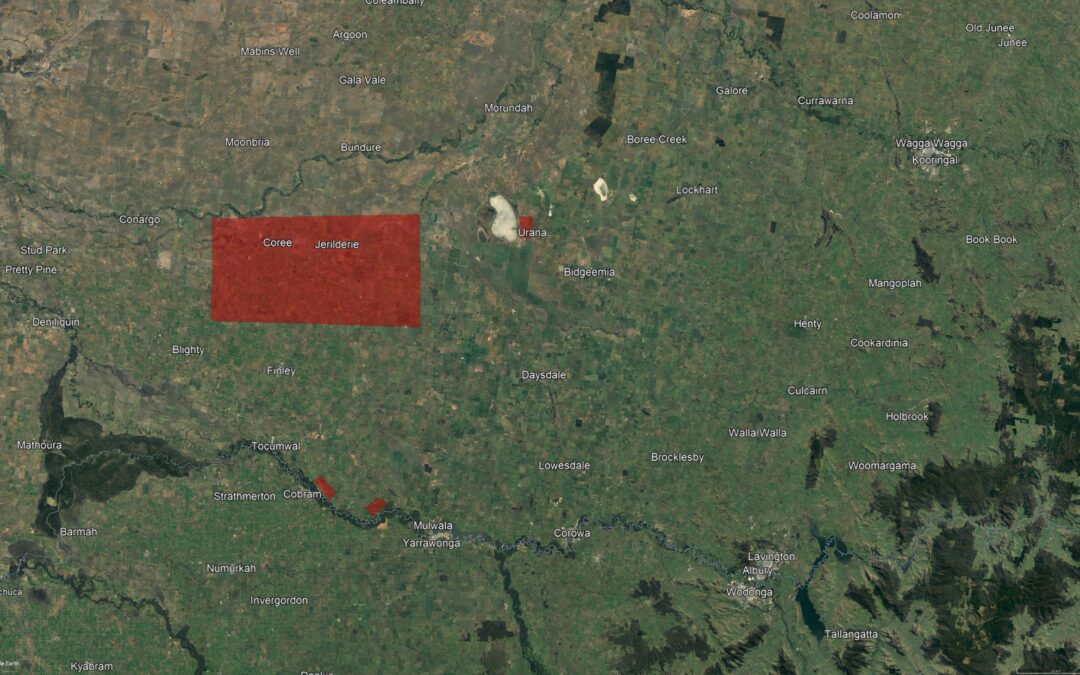
The geographic extent of the Riverina population was described as being limited to an area of ~ 55 km E/W x 25 km N/S, centred around the town of Jerilderie. This would make it roughly the same size as the main S.H-N population in the Murraylands to the south of the Morgan Rd. In addition to this main population group, there are also reports of wombats and their burrows from Wakool, 80 km to west, and along the Murray River near Barooga and Boomanoomana, 60 km to the south. It is likely that these were satellite colonies some distance from the core area of high abundance. The total number of northern hairy-nosed wombats in the area is difficult to determine with any degree of accuracy, but it was likely that it was quite large, with reports at the time describing them as ‘in the thousands’! Based on what we know about SHN population densities today, our researcher estimates that there were between 10 – 30,000 N.H-N wombats in this region at the time!
When rabbits invaded the region in the late 1870s, their impact on agriculture and the ecosystem became so bad that farmers could be – and were – prosecuted and fined for not controlling rabbits on their properties. This mandated control also included the destruction of wombat burrows to eliminate potential rabbit habitats. Sadly, in 1884 the Deniliquin Pastoral Board declared wombats to be noxious animals and placed a 5 shilling bounty on each animal destroyed (roughly between $25 and $100+ in today’s Australian dollars, depending on how it is measured). This bounty was enthusiastically pursued, with over 1,000 wombats being destroyed on one property alone in just one year. The destruction of wombats and their burrows was so effective that by the turn of the century they were either close to, or had become, locally extinct.
Our Researcher could find no records of hairy-nosed wombats in any other locations in NSW, nor were these extreme rabbit control measures discussed by any of the Pastoral Boards in any of the surrounding districts. This suggests that they were not present in any numbers in any other regions in NSW at the time of European colonisation, including along the western slopes of the Great Dividing Range, as is often depicted in ‘former’ distribution maps. Hairy-nosed wombat fossils have been found in Wellington Caves just to the south-east of Dubbo, but these are dated from around 200,000 years ago. This lack of evidence for the wider distribution of N.H-N wombats is important, and will be covered further in the next pages.