
Bernas Rewards
Berna Clements, a long-standing member of the Natural History Society, contributed much knowledge and advice on native plant identification, collection of specimens and raising seedlings for re-establishing native vegetation.
She served as Society treasurer for thirty years and provided much effort to our social activities.
A great observer of the natural environment, Berna contributed numerous articles to our journal Natural History, highlighting the pleasure to be found in observing the natural world around us.
These articles are reproduced in the following panels. Enjoy!
Your Title Goes Here
Your content goes here. Edit or remove this text inline or in the module Content settings. You can also style every aspect of this content in the module Design settings and even apply custom CSS to this text in the module Advanced settings.
The Wildflowers at Moorunde
One of the smallest is a yellow everlasting daisy no more than 1½” high when in flower. There is a bluebell which grows in patches thick enough to show the blue from a distance. These two are among the annuals, but it is on the perennial shrubs that we see most of the flowers.
There are three eremophilas – or emu bushes – Eremophila scoparia which is blue, E. glabra – red, and E. longifolia – dark pink. I have heard there is another one as well.
In the springtime yellow flowers predominate – wattles and cassias mainly.
When the seed pods of the native hop bushes ripen in the summer to red they make a fine show.
Our greatest find so far is a greenhood orchid – Pterostylis biseta – growing in an open area where in the past sheep must have grazed. As the plants grow undisturbed now there should be better displays of flowers as time goes on.
Berna Clements
Natural History, February 1971
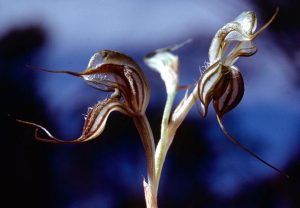
Two-bristle Greenhood Orchid (Pterostylis biseta) at Moorunde.
Rewards
Sitting quietly while female black-backed wrens dart about at your feet and a red-capped robin sits on the fence you have just been working on.
Seeing a group of six black-capped sittellas – birds you have never seen before.
Watching male trap-door spiders with their large red jaws and long pedipalps wander across the ground looking for a mate.
Putting a few drops of water on the lichen which is curled up on the ground and watching it open like a flower, turning from pale’ yellow to green.
Folding up your tent and finding under it a gecko lizard with markings on it which the aborigines could have copied for the designs on their boomerangs.
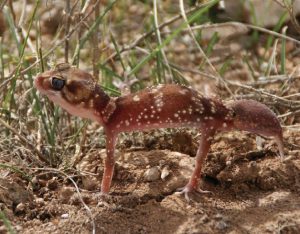
Thick-tailed or Barking Gecko (Underwoodisaurus milii).
Being screeched at by two galahs as you walk past the tree where they must have a nest.
Talking around the campfire at night. Eating damper cooked by one of the men, for morning tea.
Photographing a native cockroach, not the domestic one, but a splendid creature with pale yellow stripes, blue legs and pink antennae.
Watching one of our members paint a picture of a Moorunde scene.
Seeing a new flower and learning its name.
Meeting new people and talking to them of their interests and views.
Going for an early morning walk on your own and seeing more than 20 kangaroos.
Admiring the beautiful pink bark on the mallee trees. In the autumn they shed their old bark and the colour of the fresh bark is brighter, gradually fading as the year goes on.
Listening to the bell-like call of a pardalote, hidden not far away.
Driving to the Reserve at night and seeing a wombat walk across the road or an owlet-nightjar fly past. Waking in the morning with the song of a butcher-bird in your ears.
Small, delightful things. The list goes on and on. Each visit reveals something different.
Don’t you think we are well rewarded for the work we do at Moorunde?
Berna Clements
Natural History, June 1977
More Rewards
Do you remember how I told you before of some of the natural history we see when we go to Moorunde Wildlife Reserve to work? I called them our rewards for the work we do. Here are a few more seen by various people.
Watch a string of caterpillars in a procession across the ground.
Work away at hammering stakes into the ground and look up to see a kangaroo about 20 feet away, watching you. You walk a little way to get your camera and there is another curious kangaroo looking at you, too.
After a shower of rain, sit quietly and watch a flock of wood-swallows, on the ground feeding.
Turn over a piece of bark· and discover two large iridescent green beetles.
Find a gecko in an old log. Hold it in your hand while the camera is prepared and find that this small, indignant lizard is trying to defend itself against a human giant by biting you. Quite ineffective of course, but he tried.
As you walk along, see the numerous wolf spiders popping back into the security of their underground homes.
Sit around the campfire at night and look at the stars, much brighter when not in competition with the city lights.
Walk quietly on to a wombat warren and disturb a mother wombat and her baby. The mother dashes for her burrow but the bewildered baby walks straight towards you and you are able to pick him up and cuddle him before putting him back with his mother.
Why don’t you come up when there is a working bee and see if you can add to our list of enjoyable experiences in the field of natural history?
Berna Clements
Natural History, November 1979
Working with Nature
What a treat we had on our working bee in September. The weather was balmy and Spring was in evidence everywhere.
There were sweeping vistas of green grass dotted with brilliant yellow wattle on rounded domes of bushes. Other green bushes with a sprinkling of taller trees were scattered among the wattles. Open flats were covered by smaller bushes with white or yellow flowers. Poking up through the middle of some of these bushes were purple daisies.
Birds were darting in and out of the bushes to their nests which are so well hidden that we only spied two of them while we were there. Spiders were cautiously creeping out of their holes in the ground and popping back quickly if they saw any movement. A lone sleepy lizard was having his lunch of grass.
The wombats have been busy scratching out their burrows and tentatively opening up old burrows untenanted since the drought.
Our main purpose for the working bee was digging up weeds but who minds weeding when you can walk through such scenery as you work amid the quiet and beauty of Moorunde.
Berna Clements
Natural History, Oct-Nov 1984
A Shower of Rain
Afterwards the sun came out and there were raindrops with shimmering colours hanging from the trees. Flashes of brilliant blue, emerald green and bright red.
Then the birds became very active, flitting from branch to branch, not making a great deal of noise, except the pardalotes with their distinctive calls.
All the foliage of the trees and bushes were newly washed and looked a brighter green while down on the ground the mosses changed from their sombre brown summer colour to a light tinge of green.
In a place where water is not plentiful, quick advantage has to be taken of a shower of rain.
Berna Clements
Natural History, June 1990
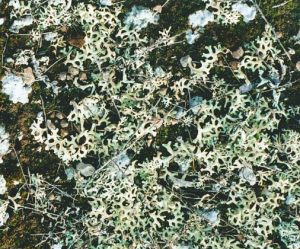
Lichen (Chondropsis semiviridis) and moss turning green after rain at Moorunde.
Some Observations at Moorunde
Have you ever wondered where the birds roost at night? We were sitting quietly at Moorunde just before dark. Along flew two mulga parrots and perched in a nearby mallee tree. They talked briefly to each other and then flew into the next tree and climbed right up into the leafy canopy.
One bird settled at once but the other fidgeted for a while before finding a spot to its liking. It was dark very shortly afterwards and if we hadn’t known those birds were there, we wouldn’t have been able to pick out where they were. They make no movements despite the noises we made.
Early next morning they were on the ground feeding before flying away.
***********
One evening before sunset two Mallee ring-neck parrots flew into a eucalyptus tree and started to nip off the leaves which they would go over with their tongues before dropping them. I picked up one of these leaves and found the remains of the sugary substance which the lerp use to protect themselves. The sugar is obviously a good substitute when there is not much blossom around from which to get nectar
Berna Clements
Natural History, May-Jun 1994
Observed at Moorunde
During the warm afternoon I saw two bearded dragons wrestling. The larger one was soon the winner. He walked away a few steps and bobbed his head aggressively a few times. After repeating this performance half a dozen times he went off into the bush.
Meanwhile the loser lay on the ground perfectly still so I approached it thinking perhaps it was injured. It slowly opened one eye, looked at me and then shut the eye. I came back in about ten minutes and it still hadn’t moved but the next time it had gone.
Berna Clements
Natural History, Sep-Oct 1994
The Reasons
Why do we keep going to Moorunde Wildlife Reserve? Yes, the Reserve needs weeding, fencing repairs and general maintenance. But are these the only reasons for going there month after month? It certainly gives a person satisfaction to be doing something for conservation, but is that all? No, it is not. There are the small events which happen, to give delight to the onlookers. Here are a few examples that we have seen during the last two working bees.
Early in the morning, waking to the melodious call of the butcher bird.
Sitting quietly watching a group of wrens flitting through the bushes as they search for food.
Finding a tawny frog-mouth’s nest and watching the progress of its young.
Seeing a lizard hanging on a branch and photographing it. It relied on its camouflage and never moved.
Watching an ant carry off a biscuit crumb. There are many ant-trails and it is interesting to follow one to its source. There are even cross-roads but the traffic never seems to get confused.
As you wander through the Reserve, see kangaroos hopping away ahead of you.
While digging some soil, disturbing a large trap-door spider which didn’t seem very upset about it.
At dusk, wood-swallows flying very high in great circles as they search for insects.
Sitting talking on a summer’s evening with bats silently swooping around.
Don’t you think we would come home mentally refreshed after all these pleasures?
Berna Clements
Natural History, Jan-Feb 1998