
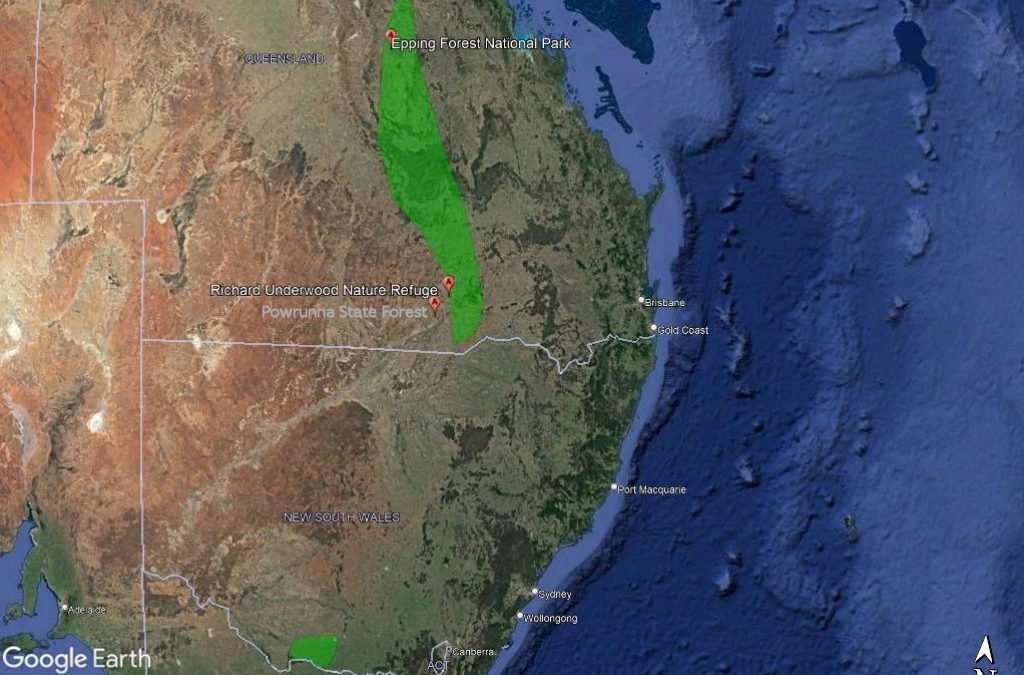
An overall distribution map for Northern Hairy-nosed wombats.
The current distribution is very small and the map marker pins show 3 places where they are now located.
The Epping Forest National Park in central Queensland was the last remaining wild, natural population, now protected by a predator-proof fence and reproducing well.
The Richard Underwood Nature Reserve colony in southern Queensland is not a ‘natural’ population; it was translocated from Epping Forest to act as both an insurance population, and to handle the ‘overflow’ as the Epping Forest population grew.
The green areas on the map show that northern hairy-nosed wombats did occur naturally in that area, so the colony there could better be described as a ‘recovery’ population in part of its former range.
Powrunna State Forest (2800 Ha, approx. 31km South West of the Richard Underwood Nature Refuge), had a third population established there in 2024, with wombats translocated from Epping Forest to expand the species’ security even further.
The Green Map Areas show the likely distribution of northern hairy-nosed wombats in the mid-nineteenth century.
Some notes about this.
- There are almost no reports of northern hairy-nosed wombats from prior to the twentieth century other than what our scientific wombat research contributor found and are mentioned on 3 previous pages. So the distribution shown on the map is necessarily based on limited information. If evidence were to come to light of colonies in other locations, we would be happy to revise the map accordingly.
- The Queensland distribution shown, while geographically large in extent, actually represents a relatively small population. All the reporting suggests that northern hairy-nosed wombats were found only in a few locations, and while these were scattered over a large area, most population groups were probably small and isolated and were unlikely to be connected to each other. This means they were also highly vulnerable both genetically and to disturbance; the latter being demonstrated by their rapid decline following European colonisation.
- Note the huge gap between the population in southern Queensland and the one located near the Murray River in the NSW Riverina. This is contrary to what you would have seen in a lot of maps which generally show the ‘former’ distribution as being a contiguous N.H-N wombat population stretching from central Queensland to the Murray River.
Our reseacher has not been able to find any evidence of hairy-nosed wombats occurring along the western slope of the Great Dividing Range in central NSW. This doesn’t say that there definitely were none there, but if there were, the lack of reporting suggests that they would have been in extremely low numbers only, scattered into isolated and vulnerable colonies that very quickly disappeared. - Information related to why our long-time wombat researcher believes the distribution looks like this is also in a previous page about southern hairy-nosed wombats.
The fossil record suggests that the species were once more widespread across the interior of the continent, but as it became more arid, hairy-nosed wombats were forced away from the interior towards the southern and eastern coasts.
Southern Hairy-nosed wombats were blocked by the Southern Ocean and now only occur in a relatively narrow strip along the southern coast, while Northern Hairy-nosed wombats came up against the geographic barrier of the Great Dividing Range.
Blocked from ‘retreating’ further, their distribution and abundance shrank as the climate became less favourable.
This climate change hypothesis has apparently not been tested yet, but it is the one that our experienced wombat researcher believes best fits the facts. If there are alternatives he would be happy to hear about it. Contact us.
The next several pages are about Bare-nosed / Common Wombat distribution.