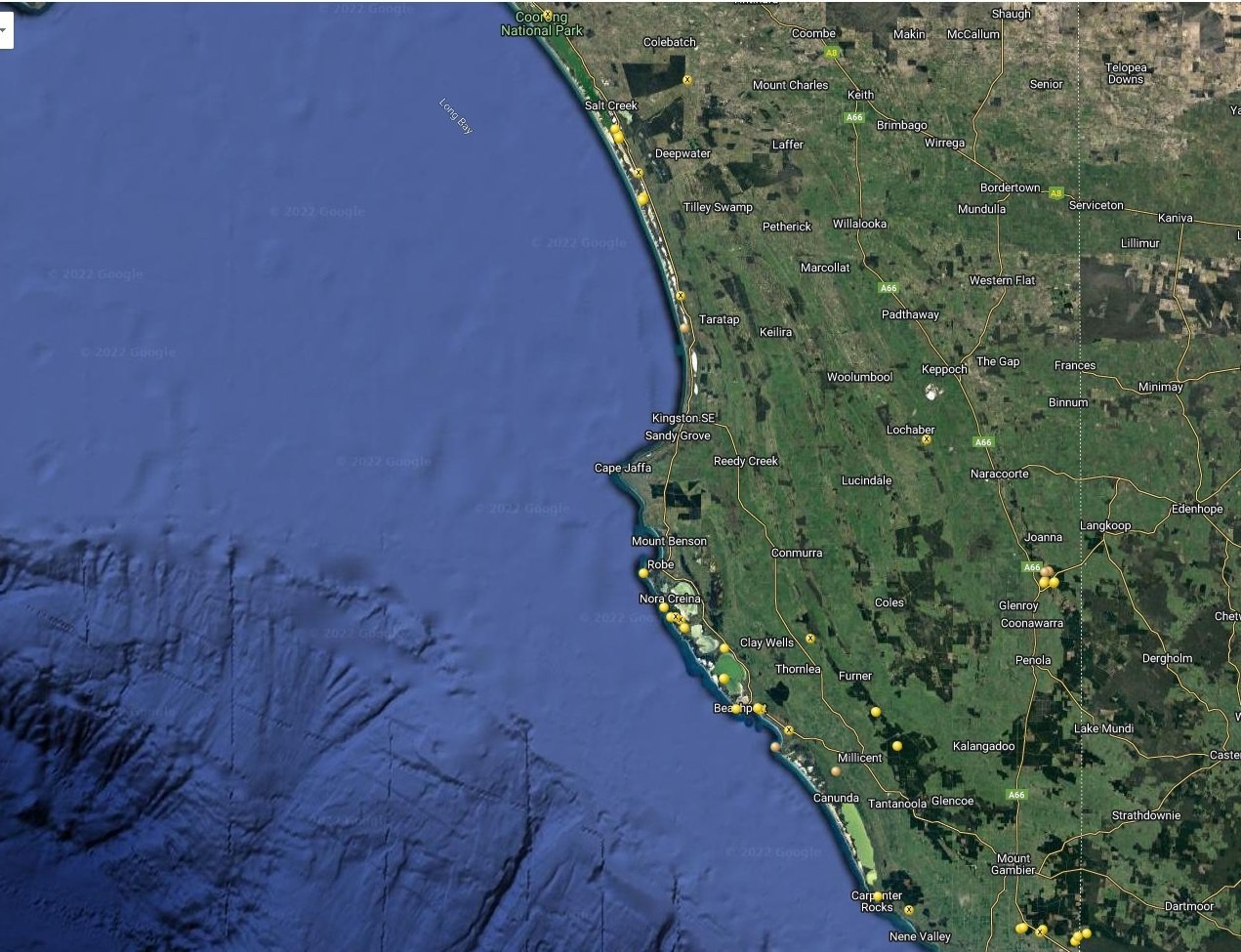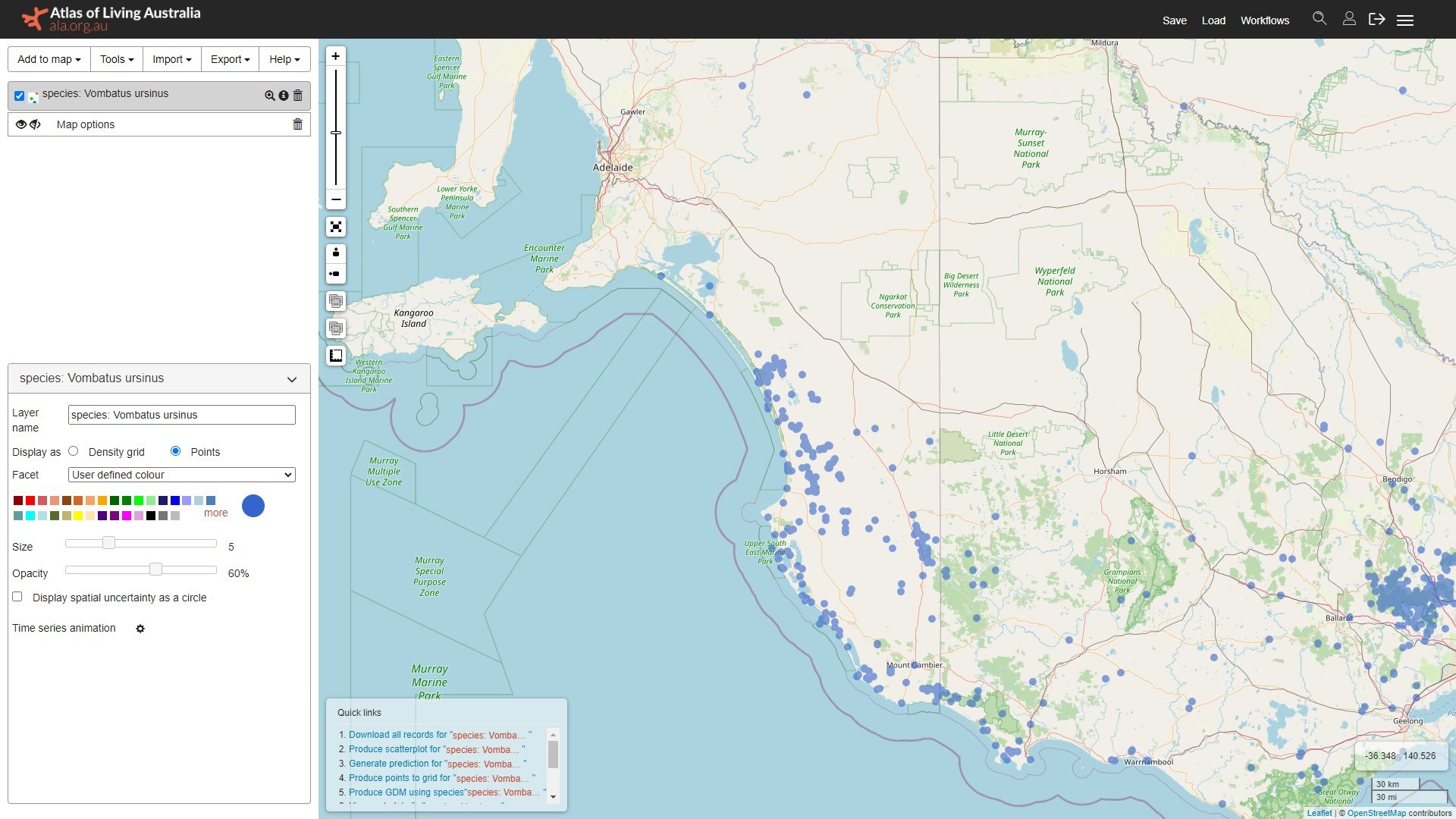
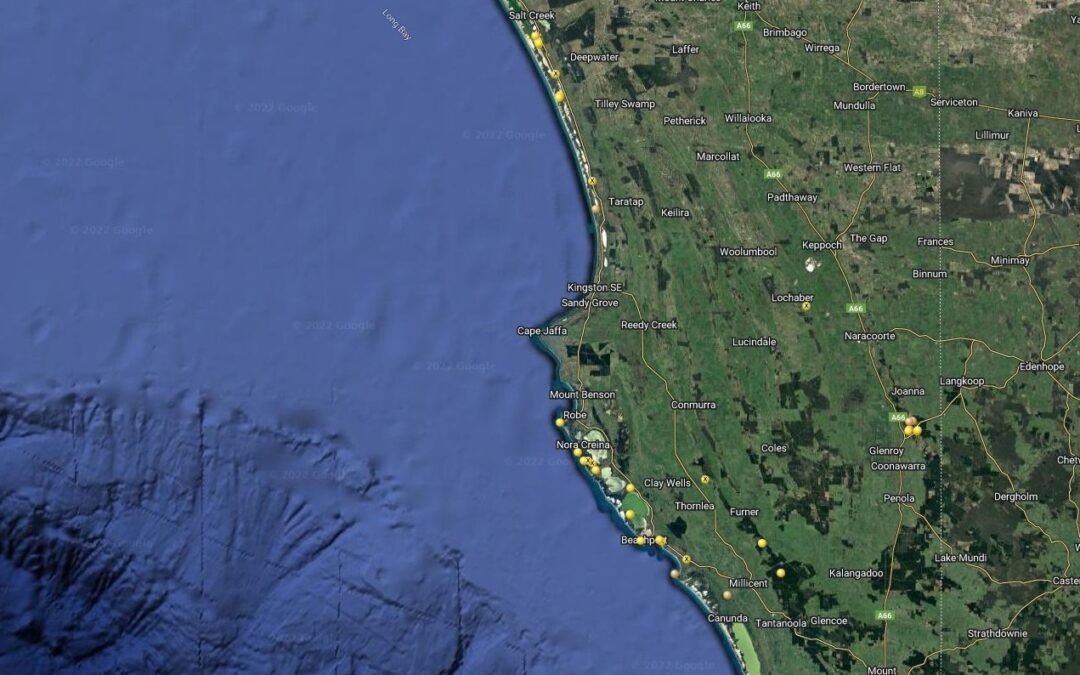
To help you understand how the distribution of vombatus has changed over the past 150 years or so, we first examine the Western edge of the species’ distribution in SA.
If you look at the WOMSAT image (satellite picture above and below) and the ALA map (towns and roads, etc) shown in the slider set below, you can see that Bare-nosed wombats can be found in the South-east corner of the state from the Victorian border along the coast and nearby inland regions to the Coorong just to the south of Lake Albert.
This is contrary to what you might have seen in some maps which claim that they are absent from SA. However, while some of the data points shown are obviously not correct (e.g the two North-East of Adelaide – would be S.H-N wombats), the researcher has undertaken a survey of the SA population over 3 years and can confirm that this is an accurate representation.
Generally, Bare-nosed wombats can be found in woodlands and areas of remnant native vegetation northwards to around Salt Creek (in the north of the WOMSAT image), with quite high population densities in some areas, especially in protected areas like the Coorong National Park.
Interestingly, one of the areas where he found the most wombats is near Salt Creek itself. This is unusual, as you would not expect to find high population densities on the edge of the distribution unless there was some form of landscape barrier preventing the population expanding. And except for anthropogenic barriers (agriculture) there are no reasons why wombats should not be found further to the north of their current extent, and we have evidence to suggest that they did so in the past.
In an 1862 description of the different wombat species in ‘The Annals and Magazine of Natural History’, the British Zoologist John Gray mentions that the Aboriginal people of the Murray River spoke of two kinds of wombats, one of which they describe as ‘big yellow fellow’, with the other being smaller and darker. This suggests that both Southern hairy-nosed and Bare-nosed Wombats could be found along the banks of the Murray River – most probably with Hairy-nosed being on the west and Bare-nosed on the east as they are today.
We have no information on how far north Bare-nosed wombats would have extended, but we can make an educated ‘guesstimate’ based on what we know about the climate and landscape envelopes they occupy. Although southern hairy-nosed prefer hotter and drier climate and Bare-nosed wombats prefer it cooler and wetter, the researcher found that there is an overlap between the two climate envelopes. He estimates that Bare-nosed wombats probably extended northwards to around where Murray Bridge / Mannum are currently located, which is about 100 km further than their current extent. Any further north than this the landscape becomes too dry.
Thanks heaps to WOMSAT and ALA for their great data and map systems!
The Next Page is about the other end of the Bare-nosed Wombat distribution – in SE Queensland.
Note: The WOMSAT and ALA maps are both in a automated slider immdiately below to compare them.
If you click and the image gets bigger, once done you can close it down by clicking the “X” at the top right of either image.