This covers how the distribution of Bare-nosed wombats has changed (or not) at the north-eastern extent of its distribution in SE Queensland.
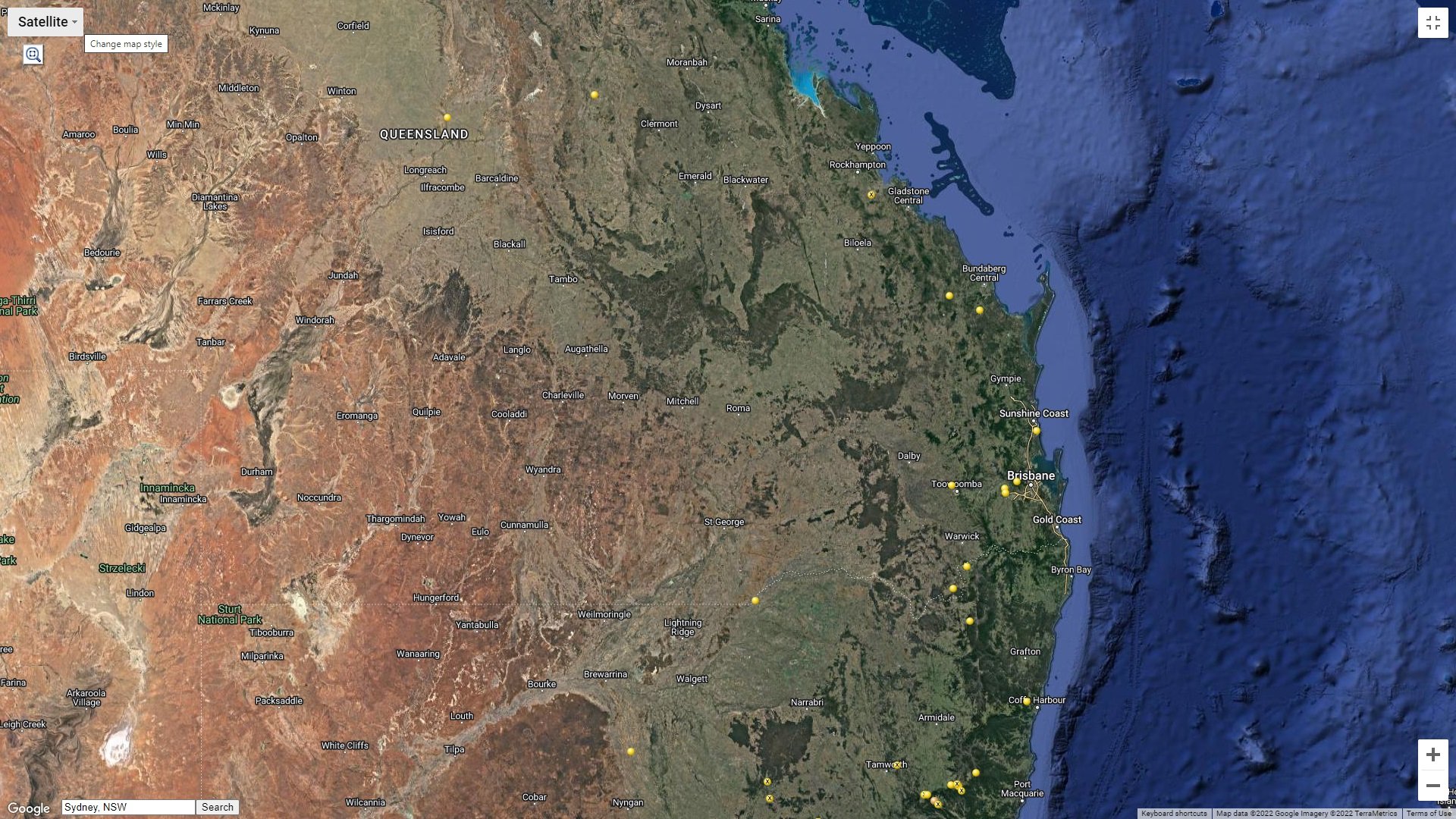
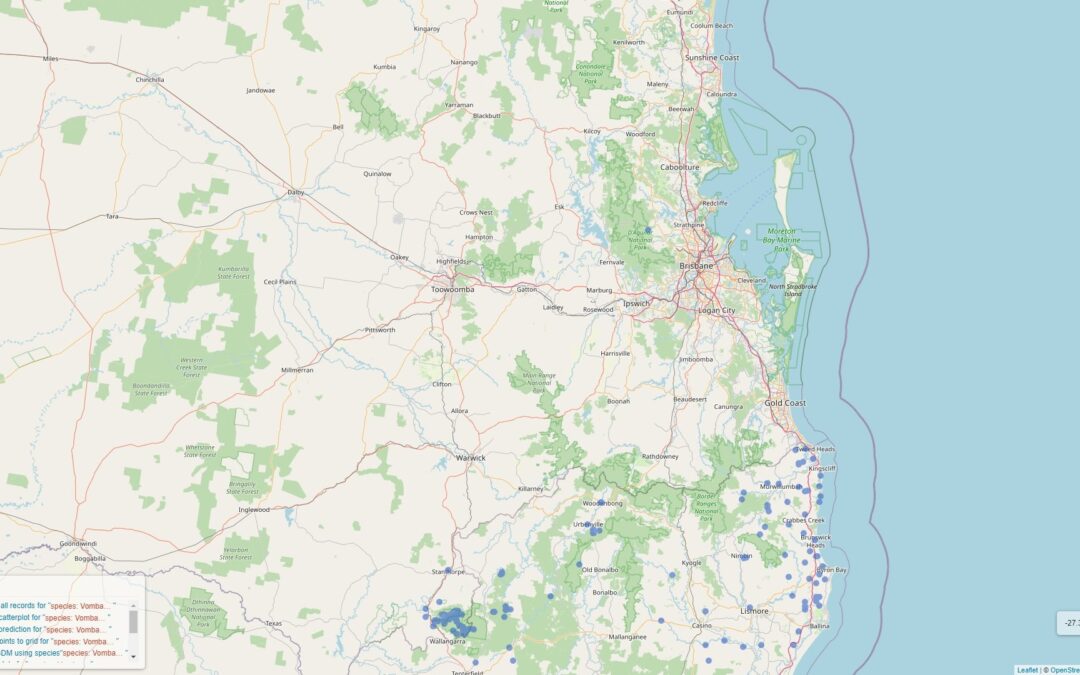
If you take a look at the two maps from ALA (towns and roads, etc above and below) and WOMSAT (the satellite image below) you might notice something strange.
Firstly, the ALA map has a fair number of reports in northern NSW, but it suggests that the distribution stops abruptly at the border, apart from one report to the north-west of Brisbane in D’Aguilar National Park. However, that report is unlikely to be correct, as the faunal survey of the park does not list wombats as being present.
Similarly, the WOMSAT map shows a number of reports which are obviously incorrect, as there definitely are no Bare-nosed wombats at any of those sites to the north of Brisbane, apart from the Northern Hairy-nosed population to the north-west of Clermont.
Our researcher has doubts about the reports in western Brisbane and to the north-west of Toowoomba, as he lived in Toowoomba for several years and knows of no colonies of wombats in the area.
He has attempted to verify the reports, but have been unable to find a second source as confirmation.
Consequently, the only confirmed reports of Bare-nosed Wombats in SE Queensland occur in the Stanthorpe / Giraween region just to the north of the NSW border; and this is also the view of the QLD NPWS service in this Targeted Species Wombat Survey PDF (PDF link opens in a new Window).
So, in essence, the most northerly extent of the current Bare-nosed wombat distribution occurs in the high country of the Great Dividing Range just over the border in SE Queensland.
But what was it in the past?
Unfortunately while there are numerous reports from the late nineteenth / early twentieth centuries of wombats occurring in the Stanthorpe region, our researcher could find no reliable reports from any other location. He found one report of wombats in the ‘Darling Downs’ area approximately 100 km north of Stanthorpe, but has been unable to verify its accuracy.
The Darling Downs is also at a much lower elevation than Stanthorpe and the climate would be much warmer, so the likelihood that there were wombats in the area is probably quite low.
Consequently, while it is possible that the size of the Bare-nosed wombat population in SE Queensland was larger in the mid-nineteenth century, it is unlikely to have extended much further north than its current extent.
Thanks heaps to WOMSAT and ALA for their great data and map systems!
The next page will cover some of the current gaps in the Bare-nosed wombat population, such as western Victoria.
Note:The WOMSAT and ALA maps are both in a automated slider immdiately below to compare them.
If you click and the image gets bigger, once done you can close it down by clicking the “X” at the top right of either image.