
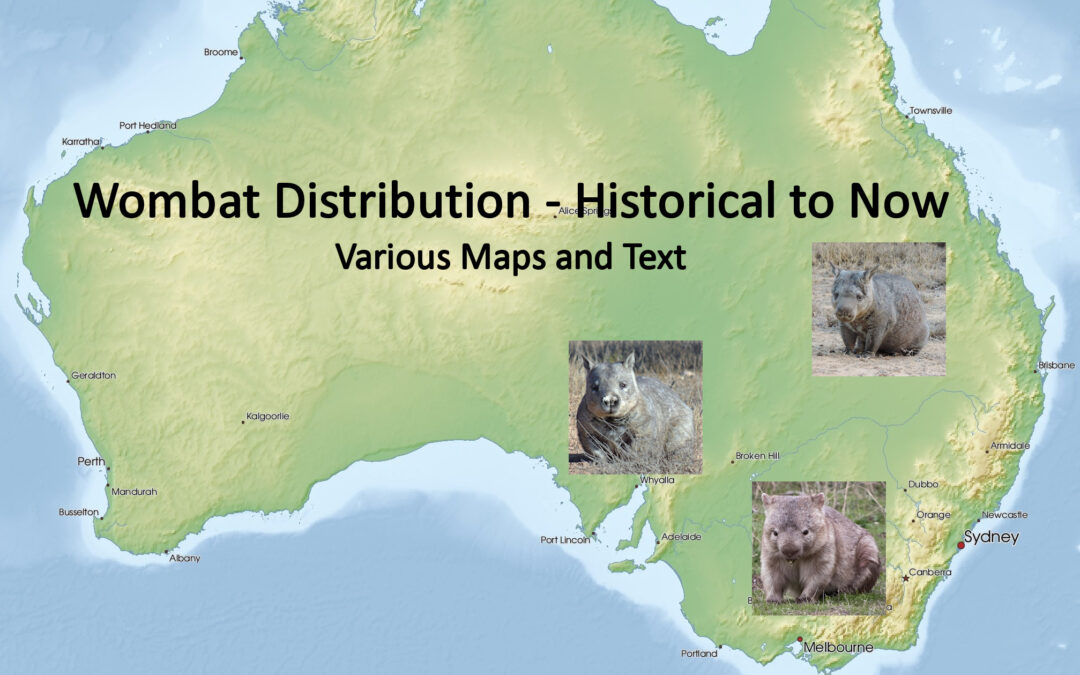
Information about Wombat Distribution in Australia
A Wombats SA supporter has been scientifically studying all 3 species of wombats and their distribution, etc for many years and believes many of the maps that show historical or current distribution of wombats are inaccurate. In addition, he suggests that the concept behind posting existing maps: that the three species are in some sort of terminal decline based on a decline in their distribution – is misleading.
So researcher Mike Swinbourne created a series of Facebook posts about it and we have permission to add this important information to our website so it’s more generally available. Click this link to see the wide range of wombat-related information posted by Mike in a new tab.
The information on this and the following pages details the thinking based on data collected over many years.
The various aspects of this sub-page set will include a more accurate map, but more importantly, it will also include commentary on some of the aspects of what we know and don’t know, and important comments on how to understand what the maps are actually telling us – they are not ‘stand-alone’ tools and to use them as such can be misleading.
Most of the information is already available if you look in the correct locations (Generally not social media!). A vital but not readily found piece is data on the mid-nineteenth century distribution of the Common / Bare-nosed wombat (Vombatus ursinus) first seen by Europeans.
Historical information related to Wombat Distribution
It is necessary to clarify what distribution maps are telling us, and what (and how) we know and don’t know.
Historical maps often purport to show the ‘former distribution’ or ‘pre-European distribution’ of wombats or other species. This can be inaccurate. Living species’ distributions constantly change in response to a range of factors, and that requires specifying the date for the distribution on any map.
While ‘pre-European’ sounds correct, it raises two questions. 1. Does it mean immediately prior to European colonisation (most do). 2. How is the distribution at that time known, in the absence of detailed records?
For the wombat maps you will see in later sections, the period of the mid-nineteenth century is used as the ‘former’ distribution, for two reasons. Firstly, it is the time when Europeans first started to drastically impact the wombat population, so it marks the point at which the ‘former’ distribution becomes relevant.
Secondly, and just as importantly, it is the time when we first started to create detailed records of where wombats could be found. These include the diaries of the early European explorers and settlers, government reports, newspaper stories, and the stories of indigenous people.
Not all of the reports found in early documents are accurate, so we need to view them with a critical eye. For example, there are a number of stories recording ‘wombat holes’ in many locations where they simply could not exist. After careful investigation, the researcher has concluded that these were most likely the warrens of burrowing bettongs or other species, and the early European colonists just generically labelled them all as wombat holes.
The next page talks about what distribution really means and then covers the likely distribution of the three species in current times.