
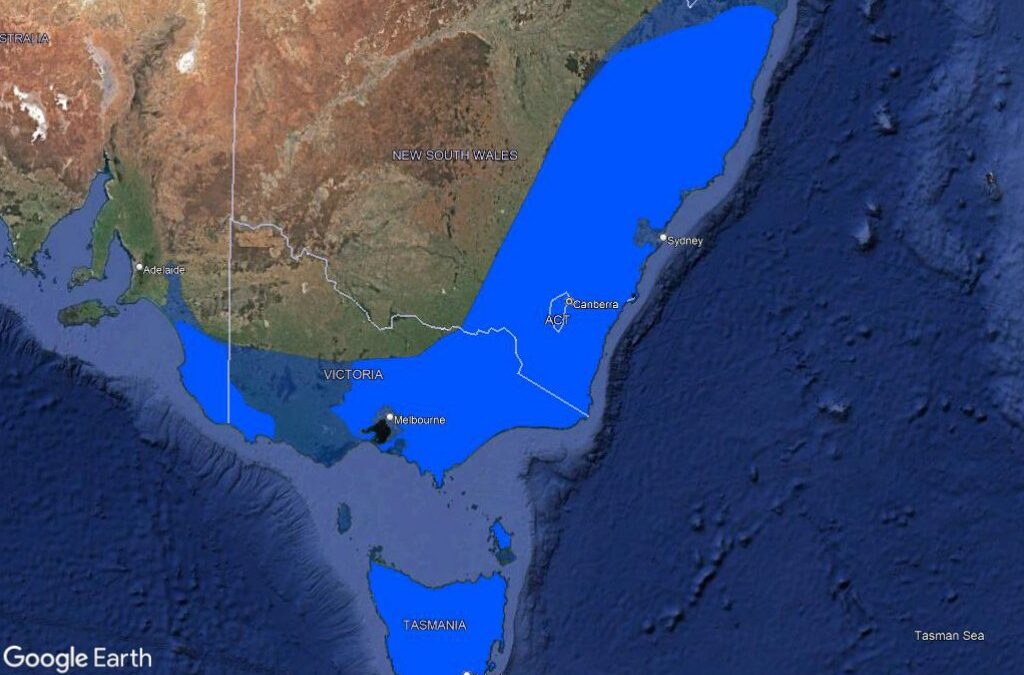
Bare-nosed Full Distribution Map of Bare-nosed wombats
The map above shows the likely current and early nineteenth century distribution of Bare-nosed wombats. However, there are a number of important considerations that need to be kept in mind when looking at the map.
The first is that, unlike for Hairy-nosed wombats, no-one has done in-depth research on how the distribution of Bare-nosed wombats has changed over time. Consequently, the map shown is necessarily based on a relatively short assessment process. The sources used were the ALA, WOMSAT, and distribution maps produced by the respective state parks and wildlife services.
Much of the information contained in these sources is at odds with some of the maps you might have seen on the internet purporting to show the present distribution – and some people may disagree with what is shown. However this based on the evidence found, and if there are reports of wombats in an area and no contrary evidence has been found, or it simply does not make any sense, it should be included within the current distribution map.
Please be aware that there is a ‘generic’ element to some of the distribution outlines.
For example, wombats are present on Flinders Island, so the map shows the entire island as part of the distribution. However, whether or not they can be found over the entire island or only parts of it is not clear. This would require a more detailed study has not yet been done as far as we know.
Past distribution information is based on a relatively few reports from early colonisers and First Nations’ stories, as well as projecting likely locations from what we know about the preferred environmental envelope of the species. So if new information is presented, our experienced researcher would be happy to make changes based on any valid information is put forward.
There are also some interesting anomalies regarding where wombats were reported to be found in the early days of European colonisation. On an earlier page about Bare-nosed wombats it was mentioned that they were not encountered by Europeans until 1797 in Bass Strait, and were essentially unknown by the colonisers in the Sydney area until they started to expand into the foothills of the Blue Mountains. This suggests wombats were absent from the Sydney basin at the time. However, this is quite strange, as today they are known to be present in the Ku Ring Gai Chase National Park to the north of the city, and in the Royal National Park to the south. Perhaps they were present in Sydney in 1788, but the colonisers simply did not spot them? It does not seem logical that they are recent arrivals in those national parks, so it seems they probably were present in the Sydney area in the past in small numbers / limited areas.
Again, this is possibly a contentious view, so if anyone can provide compelling evidence or argument to the contrary, our researcher would review this.
Also, distribution maps only provide an outline envelope of where the species can be found. THIS POINT IS EXTREMELY IMPORTANT.
As previously mentioned there will naturally be many areas inside the envelope from where, because of unfavourable landscape factors, wombats are absent. This is especially true in the case of Bare-nosed wombats. Because the species is found in the south-east of the Australian continent, it has been substantially impacted by urbanisation. So while the distribution envelope shown in some areas is largely contiguous at the broad scale, there will be large gaps where there are few, if any, wombats because of human population centres or other unfavourable landscape factors within the envelope’s boundaries.
Because of this it is difficult to provide an exact distribution envelope in some areas, especially around population centres. The major population centres of Sydney / Newcastle/ Wollongong / Melbourne are excluded from the current distribution (not Canberra, as there are reports of wombats occurring in remnant bushland within the city boundaries). Plus, because Bare-nosed wombats are largely a woodlands creature, it has been much more heavily impacted by land clearance for grazing agriculture than southern hairy-nosed wombats, which prefers open grasslands (both are affected by land clearance for cropping). This combination of urbanisation and land clearance has created, in many areas, a patchwork of population groups surviving in areas with favourable landscape factors (e.g. remnant vegetation).
Thanks heaps for the great photos of Bare-nosed wombats in forested areas Jarake Wildlife Sanctuary. Click this link to see what they do.
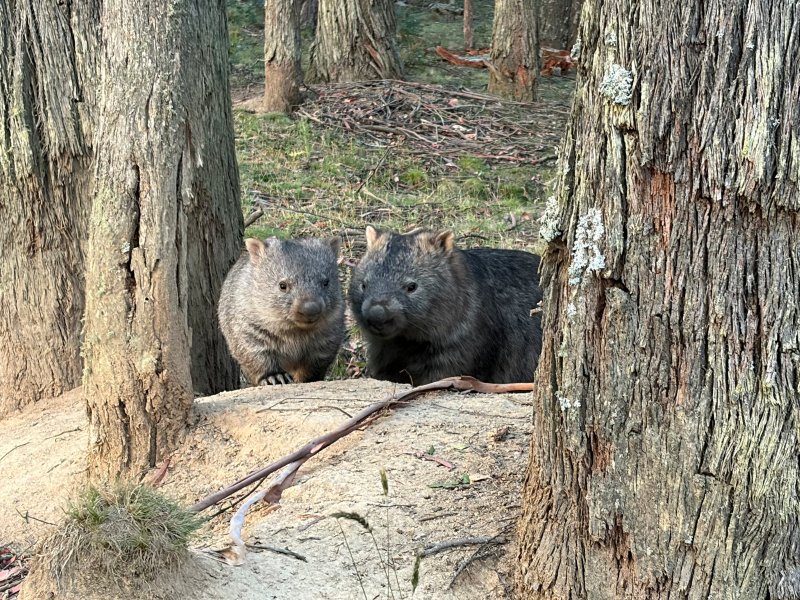
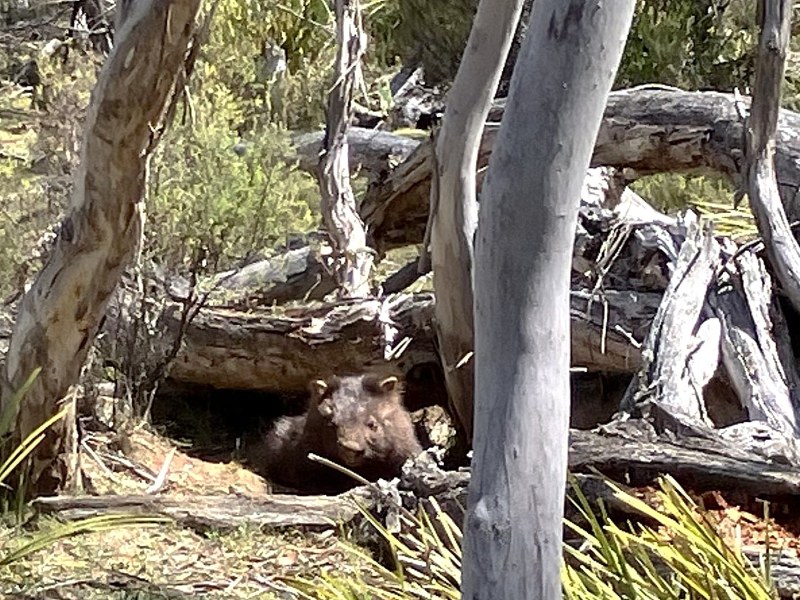
When constructing a distribution map, scale is an important consideration. How far apart do colonies need to be before they should be shown as separate distributions? Unfortunately there is no right answer to that question, and it will always be a subjective judgement. When constructing a species-wide map such as this, it is difficult to single out every colony or small population group and draw a separate circle around them. However, if you were to construct a regional or small scale map, such an approach would be appropriate.
In the case of Bare-nosed wombats, this is the real story – not the simple distribution map. The map appears to show that there has been little overall change in the distribution of the species – and that is essentially true. There is no past information of wombats occurring outside the distribution envelope shown, and based on what we know about their preferred environmental envelope, it is unlikely to have been significantly larger. And there are numerous reports of wombats right up to the edge of the envelope in all areas today, indicating that the overall distribution has experienced little change.
Note that most of Western Victoria shows as ‘wombat free’, despite the fact that some wombats can actually be found in the region. This is because their numbers are known to be extremely low and limited to small, isolated colonies in geographically restricted areas. Because they are so few in number, it could give the wrong impression if the region were to be included within the distribution envelope. The approach is that while wombats are present, they are essentially ‘functionally extinct’.
Again, some people might argue that’s not a valid assessment, but our experieiced researcher saysthr approach is arguably supportable.
NOTE the important distinction between distribution and abundance. As mentioned before the two concepts are not the same, and while the overall wombat distribution envelope may not have changed substantially at the species-wide scale, abundance is likely to have declined significantly – and in some areas it has declined catastrophically – throughout much of that range due to human influences. However, that is not universally true, and it is also likely that human influences have proved favourable to wombats in some areas (e.g. removal of predators such as the thylacine, changed fire regimes, vegetation changes). As a result, abundance would be higher in these areas, and recent effective rabbit control measures and the inclusion of more effective legal protection for wombats means that the overall population has been recovering over the past few decades from historical low levels – albeit with ongoing and more recent declines at the regional scale because of effects such as disease (mange).
But overall, the negatives have most definitely outweighed the positives, and vombatus numbers would be much lower now than they were in the early nineteenth century.
The next/last page has a ‘former’ and ‘current’ distribution map of all three species on a single image